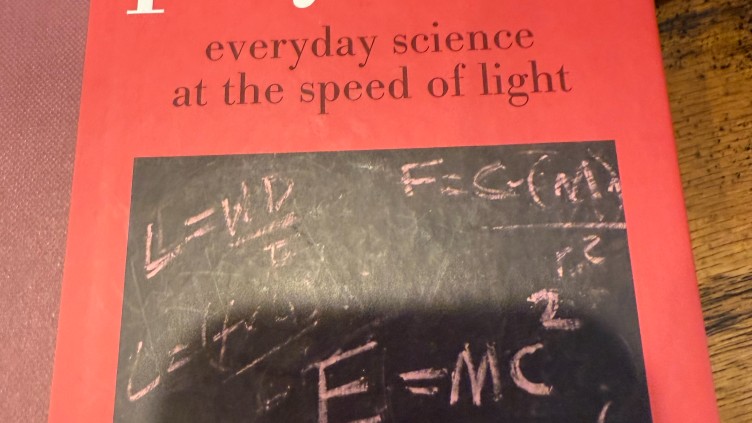
Avoid If You Don’t Like Science
Niels Bohr, the father of quantum physics — a science filled with paradox — wrote,
- The opposite of a profound truth may well be another profound truth.
- Those who are not shocked when they first encounter quantum theory cannot possibly have understood it.
- Everything we consider to be real is made up of things that cannot be regarded as real.
- We should stop telling God how to handle his dice.
- It is important to be clear when discussing atoms. Language should be used in a way similar to poetry. A poet is not primarily focused on describing facts but on creating images and establishing mental connections.
Sir Isaac Newton (1642-1727) invented calculus, developed the theory of light and color, formulated the law of gravitational attraction, and possessed one of the greatest minds in history. The three laws of motion were perhaps his most outstanding achievement: First Law of Motion — A body at rest remains at rest, and a body in motion remains in motion until acted upon by an outside force. Second Law of Motion — The force applied to a body produces a proportional acceleration directly dependent on the mass of the object. Third Law of Motion — To every action, there is always an equal and opposite reaction.
Electronics: In a series of experiments from 1820 to 1830, Michael Faraday produced an electrical current by inducing motion in a magnetic field, ushering in the modern age of electronics.
Electrodynamics: James Clerk Maxwell’s equations on electrodynamics may be the most significant development in nineteenth-century physics. He demonstrated that an oscillating electric charge produces an electromagnetic field. Additionally, Maxwell developed a comprehensive mathematical description of electromagnetism, demonstrated that light waves are essentially electromagnetic waves, clarified radio waves, gamma rays, and x-rays (which had not yet been discovered), and established a mathematical approach for calculating the speed of light, all before dying of abdominal cancer at age 48.
The Atom: 2,500 years after Democritus, John Dalton (1766-1844) presented a pragmatic view of atomic theory. In 1905, Einstein won the Nobel Prize for proving that atoms caused the random movement of pollen grains in water (Brownian movement), making atoms “visible” for the first time.
J. J. Thompson won the 1906 Nobel Prize for discovering the electron. He also had seven students, and his own son went on to win a Nobel Prize.
Ernest Rutherford (1871-1937) discovered the atomic nucleus, the proton, and three forms of radioactive elements. He predicted the existence of the neutron and contributed to the development of the modern atomic model.
Archimedes–the man who ran through the streets naked in the third century BC shouting eureka–“I found it, I found it.” He had “found” the principle of buoyancy by floating in the bathtub. The displacement of water enabled him to determine how much gold was in the crown of King Hiero II of Syracuse.
Bathtubs remind me of Winston Churchill, who spent hours in the bathtub writing and rehearsing speeches. Perhaps if we spent more time in bathtubs and less time in showers, we would be smarter.